




• The first Queen of Romania, Elisabeta, Princess of Wied, marries Carol I of Romania in 1869.
Princess Elisabeta von Wied came to Romania in 1869, at the age of 26, to marry Prince Karl von Hohenzollern, who ruled under the royal name of Carol I of Romania. At that time the Principality was under the tutelage of the Ottoman Empire. After the War of Independence in 1877 and the Treaty of Berlin in 1878, Romania was recognized as a kingdom, and Elizabeth thus became the first Queen of Romania.
It is well known that the Royal House of Romania was the poorest in Europe. The Steel Crown, Romania's iconic royal crown, was cast from the barrel of an Ottoman cannon captured during the War of Independence, in the battle of Plevna, and Carol I chose steel, and not gold, to honor the bravery and sacrifice of the Romanian soldiers. It is believed, however, that the choice of steel and not any precious metal was also due to an economic necessity.
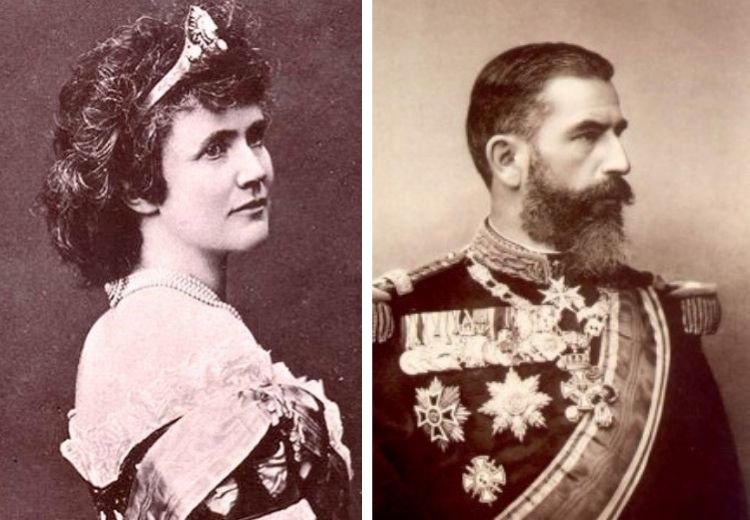
Elizabeth I – supporter of Romanian art and culture
However, after Charles I is proclaimed king, the new Queen Elizabeth, apart from her involvement in social and charitable activities, also becomes an ardent supporter of the arts and philanthropic acts. Young budding artists were welcomed into his entourage, such as George Enescu and Elena Văcărescu.
She also supports the work of Nicolae Grigorescu and Vasile Alecsandri. In an era when it was fashionable to buy works by the Italian and French classics, Elizabeth I of Romania bought works signed by Grigorescu, thus launching the fashion of purchasing plastic works by Romanian artists.
Among those close to the Romanian royal house were Mite Kremnitz and Titu Maiorescu, through whom the Queen met Mihai Eminescu, whose admirer she was.
Queen Carmen Sylva – Among the first "working" queens of the world
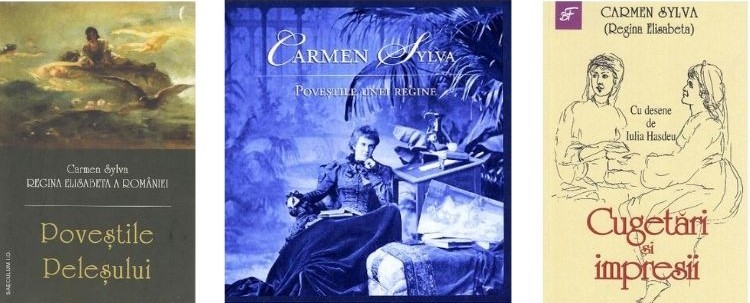
Nicknamed the writer queen, she will publish poems, fairy tales, stories, novels, memoiristic works, under the pseudonym Carmen Sylva, "Song of the Forest" in Latin.
He contributed to supplementing the revenues of the royal house in Romania through a series of "testimonial" advertisements for typewriter manufacturers, advertisements printed in major European newspapers. His writings will reach Germany, France, Great Britain.
Carmen Sylva was also a very good translator, translating many of Vasile Alecsandri's writings into German, as well as the works of the famous French writer, Pierre Loti.
Following their meeting, Loti is deeply impressed by the Queen and describes her as follows: “The Queen is tall and well made. His eyes are blue and a little uncertain; look closely at the eyes of others to guess their thoughts more quickly. When you know how much these eyes have wept, their intense azure and their brightness excites like a heroic thought. Finely arched eyebrows have extraordinary mobility; the harmonious mouth is accustomed to smile, revealing very white and beautiful teeth, rich brown hair, often proves to be less disciplined; the hands are very beautiful, and the step, impatient, is nicely arched; her whole being was rather pretty than beautiful, and even more graceful than pretty. Beneath this glow of intelligence, of kindness, of sincerity, with which he welcomes his guests to make them feel better and urge them to speak more quickly, there is the shadow of a deep modesty, an ingenuous wonder, when he responds to the appellation of Your Majesty, a seeming oblivion of rank, which highlights even more the sparkle, which he knows how to control, enveloping those he meets."
Romanian cultural ambassador

From a letter addressed to George Enescu, dated 1900, we learn that Elizabeth I, among the personalities of Romanian culture, appreciates Vasile Alecsandri, Nicolae Grigorescu and George Enescu the most: "Grigorescu exhibited some wonderful paintings. I told him that three Romanians understood this wonderful country: he, Alecsandri... and the third is still very young and his name is George Enescu."
This appreciation turns her into a promoter of Romanian culture and its representatives abroad, but also reveals the queen's expectations from the three to put their talent and creativity at the service of the country.
Starting from 1800, the Queen will publish a series of writings in which she will describe the Romanian space and its inhabitants, making Titu Maiorescu recognize the great role she had in the era of making known Romanian literature, the Romanian folk costume, art and Romanian culture in the West.
The queen and the great poet Eminescu
The writings of the time tell us that Elizabeth I was a passionate reader of Eminescu's poems, whom she repeatedly invited to the cultural evenings supported by the royal house. Relations between Mihai Eminescu and King Carol I were quite tense after Mihai Eminescu characterized the king, in an editorial in the conservative newspaper Timpul, with the formula "Carol the Giver".
Although there were several meetings with long literary discussions, the poet could not join the circle patronized by the queen.

Carmen Sylva will describe the poet in his words: "He appeared to us restless and disheveled, as if he had come from another world; he reminded me of Manfred and Faust, of the pale and battered faces of the great romantics... He kissed my hand, looking at me with a subdued but penetrating look, which seemed to want to dry up my spirit, to remain a subject for him out of curiosity or interest, I feel sorry for not knowing enough about his native Moldova. His eyes searched far, beyond the walls... His facial features betrayed the fatigue of a youth lived without joy. His fingers were long and frozen, his very expressive mouth with soft lips translated all his emotions. He had a hoarse, but tender voice, like doves in autumn... When I praised his lyrics, he shrugged his shoulders: "The lyrics fall away from us like dead leaves from trees," he sobbed.
Incurable romantic and protector of true love
Although aware of the impossibility of marriage between a member of the royal family and an ordinary person, she protects the idyll between her maid of honor, Elena Văcărescu, and Crown Prince Ferdinand.
The particularities of the scandal caused at that time are reproduced in Constantin Bacalbașa's book, "Bucureşti de alţodătă". In order to settle the conflict and restore the impression of public opinion regarding the royal house, Charles I decides on a period of exile for those involved. Elena Văcărescu leaves for Paris forever, Elisabeta will spend two years in Neuwied, in Germany, and Ferdinand will be sent on a business trip through Europe, on which occasion he will also meet the future queen, Maria of Edinburgh.
Cigarettes and Cake "Carmen Sylva"
If the queen's notoriety led a Bucharest tobacco manufacturer to create the cigarettes that bore her name, the "Carmen Sylva" cake was apparently created at the request of King Carol I.
The cake recipe appears in a cookbook from the second decade of the XNUMXth century signed by Maria General Dobrescu.
As the queen's love for chocolate and coffee was well known, on her 50th birthday, Carol I asked the royal chefs to prepare a special dessert for Queen Elizabeth, which would combine the festive occasion with the celebrant's favorite flavors. This is how the "Carmen Sylva" cake was born, a special dessert for an exceptional historical figure.
A special dessert

Maria General Dobrescu records the preparation method as follows: "Mix the butter with the sugar, add the chocolate heated in the oven, then rub it for half an hour, add the yolks and whites, foam, with the flour. It is poured into the lined form and baked at the right temperature. Spread with the following cream: boil the chocolate sugar with water until it thickens. Leave to cool, mix with the egg yolks, then with the whipped cream. Or another cream: boil chocolate with sugar and coffee essence until a thick syrup is obtained, which is poured hot, drop by drop, over the yolks, mixed well and left to cool; then mix with freshly foamed butter, which has been rubbed with a spoonful of powdered sugar, mix well all together, then glaze and fill the cake. It is good that the tops of the cake are sprinkled with rum. "
Historical desserts reinterpreted in a modern way
Ana Consulea, pastry chef with numerous international awards, will reinvent historical desserts, reintroducing them into the current gastronomic culture. Thus at the Zexe confectionery we will find historical desserts, such as George Enescu, Take Ionescu or Regina Maria and Carmen Sylva cakes.

About the Carmen Sylva cake, Ana Consulea, in a intervened she said: "I love making Carmen Sylva cake. It was originally a cake, and I created the cake, thus giving it a personal interpretation. I changed the coffee cream and made it much lighter, more airy, removed the butter cream in which it was dressed and put a "belt" of almonds with butter, eggs and sugar. This border, with the Romanian national pattern, is my touch."
Article written by Gabriela Dan, Editor of Arta Albă
Read on White Art and: Interview with Pastry Chef Ana Consulea – Mood creator at Zexe Brasserie and Zelato

