




• The first cookbook printed in Romanian appeared in Iași, in 1841, under the title "Book of noble recipes - 200 recipes for dishes, cakes and other household chores".
In 1841, in Iasi, it appears "Book of noble cooks - 200 tried-and-true recipes for dishes, cakes and other household chores", signed by MK and KN, only with initials because it "didn't fit" for two intellectuals to deal with "women's or too worldly affairs".
Under the mysterious initials it will be proven that there are two well-known writers and politicians of the time, Mihail Kogălniceanu and K(C)ostache Negruzzi.

Mihail Kogălniceanu later publishes a text in which he reveals the identity of the authors of the cookbook: "I will tell you this much that I recently published - together with Mr. CN, another Prometheus manque like myself - a book that, overturning all the powers seated, trampling on all the rules received by the assembly and the custom of the land, he has to make a terrible revolution in the whole of Moldova in the form of making friganes and dumplings; I want to talk about a collection of 200 recipes of dishes, which will make us the best reputation among cooks and the grateful future will undoubtedly give us the beautiful name of: the introducers of the culinary art in Moldova. We are satisfied with that."
"Introducers of culinary art in Moldova"
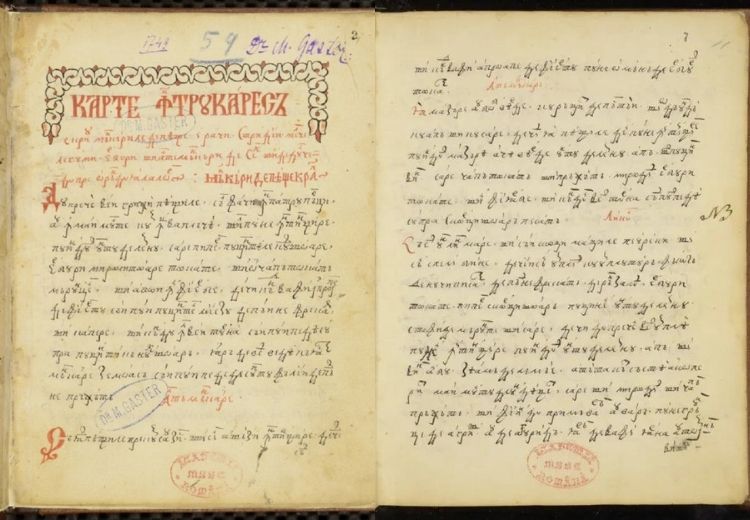
Before the book of the two, the oldest cookbook dates from the XNUMXth century, around the reign of Constantin Brâncoveanu and is a manuscript made in pen on a filigree sheet. The manuscript, bound in leather, is part of the Library of the Romanian Academy and comes from the Moses Gaster collection.
Mihail Kogălniceanu and Costache Negruzzi propose that, for the first time in the history of Romanian publications, they create a work that lays the foundations for the terminology of culinary art. Thus, by collecting both local recipes and studying works in French and German, already published in the era, the two manage to establish through their writing a generous list of terms specific to gastronomy. This approach, avant-garde at the time, benefited from the talent of the two authors in analyzing and synthesizing a large volume of information, in order to artistically transpose it in the pages of the first anthology in the field of Romanian culinary art.
Openness to European culture
The book of the two is truly a collection of noble recipes, especially because of the ingredients needed to make the dishes, ingredients that were not available to anyone in the Romanian space of the 200th century. The volume includes XNUMX recipes and household tips, but most of them are adaptations for the Moldovan taste of Parisian, Viennese or Berlin recipes, capitals where the two have lived over time.
The recipes are "tried", and given the exotic ingredients used, the fact that the authors were part of the nobility gives them the means to have access to these ingredients, as well as the opportunity to experiment in the kitchens specific to the noble mansions. The ingredients, the names of some recipes, but also the openness of both authors to European culture undoubtedly show the foreign origin of many recipes in this book. So: Fashionable ox comes from the French "Boeuf a la mode", pigeon in papillotes (Pigeons in waxed paper, from the French “papillote”), Pate (pie, from the German "patete") of mincing, Lentil cake (cake with a layer of jam, from the German "Linzer Auge"), Milhbrod (bread with milk, from the German "Milchbrot"), Mandel cuhen (cake with almonds, from the German "Mandelkuchen") etc.

Recipes and useful "remedies" for households
The stated intention of the authors was to borrow from foreigners in order to revolutionize the society in which they lived.
Mihail Kogălniceanu even writes about his effort to borrow and bring to Romanian society the example of European culture: "Growing up and living a large part of my youth in those countries that stand at the head of Europe, I was and am of the opinion that in the century In the XNUMXth century, it is not forgiven for any nation to limit itself to what it has, without borrowing from foreigners".
In addition to the recipes, the two authors also propose some useful "means" for households "to keep walnuts fresh for a whole year", "to remove excess salt from overly salty dishes", "so that the hens can lay eggs in any weather" of the year", "to clear the cloudy wine", "to remove the smell of wine from the wine" or "to be able to keep fresh meat for several weeks in the summer".
Passion for culinary art
The passion of the two for the culinary art is underlined by their writings and correspondence with members of their families.
Costache Negruzzi gives us information about the culinary art of the era in the letters published in the volume "Black on White": "Come with me to the country and follow the diet that I follow: In the morning we will eat chops and you will drink a glass of porter (dark, strong and bitter English beer) instead of decoction; for lunch ham, macaroni, chicken, with Odobești wine. In the evening we will come home tired, we will drink a ponci to cool off; then we'll have a rabbit stew for dinner." (Letter IV, May 1838).

"...the fashion for choice foods had not yet been introduced"
Negruzzi's opinion about the lack of sophistication of Moldovan cuisine is also captured in his writing Alexandru Lăpușneanul, even if the action depicted took place almost three centuries before. "In Moldavia, at that time, the fashion for selected dishes had not yet been introduced. The biggest feast consisted of several dishes. After the Polish borscht, came Greek dishes made with greens, floating in butter; then the Turkish pilaf, and finally the cosmopolitan steaks. In the courtyard, besides two bullocks and four roasted rams, there were three unstopped wine bottles; (…)"
In the case of Mihail Kogălniceanu, his passion for gastronomy emerges from the correspondence with his sisters, in which we frequently find family recipes requested by the politician to his relatives in the country.
Talented connoisseurs of the artistic word, Mihail Kogălniceanu and Costache Negruzzi are revolutionizing the Romanian cultural space by paving the way for the creation of a vocabulary in the field of culinary art, an approach both avant-garde and full of charm.
Article written by Gabriela Dan, Editor of Arta Albă
Read on White Art and: Herbal mixes and concentrates in baking, pastry and confectionery


I like it very much, sorry.