



• LU Petit-Beurre is undoubtedly the most famous biscuit in France and also one of the most consumed worldwide. With a history of over 130 years, the famous snack, seemingly simple, has a story as interesting as its fine taste.
We have all had the opportunity, at least once in our lives, to taste this small rectangular treat with a rather unusual design. But probably not everyone knows the story of the crispy Nantes dessert, unchanged throughout its history.

The story LU brand it began with the arrival in Nantes in 1846 of Jean-Romain Lefèvre, a confectioner originally from Varennes-en-Argonne. He married Pauline-Isabelle Utile in 1850, the two deciding to buy the patisserie where Jean Romain worked and turn it into a "Reims Biscuit and Candy Factory."
In the beginning, the business was modest, and the biscuits were sold straight from the oven, on a table in the patisserie's courtyard. Success came quickly and the couple opened a second store in 1854 under the name "Lefèvre-Utile". As a result, Jean-Romain was awarded the gold medal at the Nantes Industrial Exhibition in 1882 for the quality of his biscuits. But health problems took his life the following year, leaving the business in the hands of his wife and youngest son, Louis Lefèvre-Utile.

It was Louis Lefèvre-Utile who turned the small family business into a biscuit giant. Back then, the French mainly imported these snacks from England, produced on assembly lines in mechanized factories. The sector champions at the time were Fry's and Cadbury. But LU plays the card of simplicity with Petit-Beurre, which contains just four ingredients: flour, butter, sugar and milk. It was this simplicity that earned them the Grand Prix for Biscuits at the 1900 Universal Exposition in Paris.

Special packaging
In the late XNUMXth century, biscuits were sold in bulk. Louis was the one who opted for the modernization of packaging, introducing cardboard boxes and later tin ones. They represented a guarantee of quality, the biscuits sold in the new packaging keeping their freshness longer. At the same time, this way of packaging was ideal to be given as a gift.

 Lefèvre-Utile's advertising was based entirely on the quality of the product. This was certified by the fact that the company's products constantly won competitions and medals. Proud of these distinctions, Louis Lefèvre-Utile illustrated them on his packaging, crafting advertisements to seduce the consumer's eye.
Lefèvre-Utile paid particular attention to the aesthetics of its packaging and biscuits. Therefore, he involved various artists in developing the brand's advertising. He initially turned to local artists, then to Parisian and foreign artists. Between the years 1896 and 1903 he collaborates for the image of the company with Alphonse Mucha, the promoter of the Art Nouveau artistic movement, in 1903 Mucha painting a portrait of Sarah Bernhardt for the advertising campaign of the LU company.
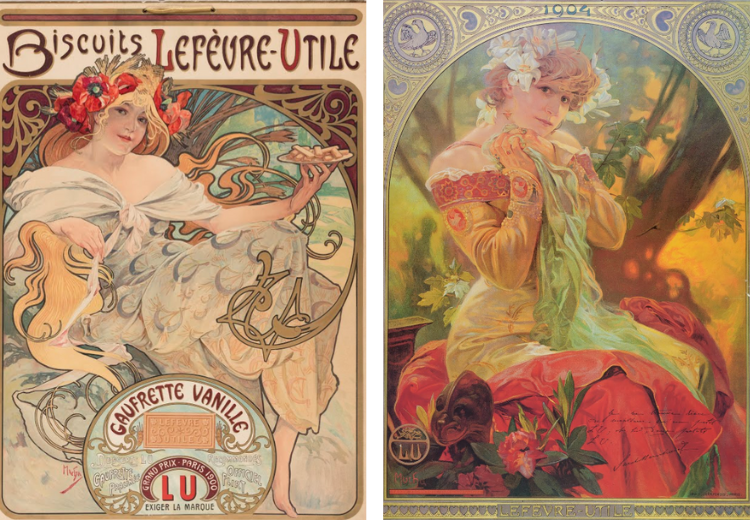
The company's advertising images are truly works of art. Inspired by Art Deco, they were used as posters, mural advertisements painted on building pediments, billboards attached to trams or displayed at major events such as World Fairs.
At the beginning of the 200th century, the LU company offered a catalog of 1898 different biscuits, which were first marketed in France and then exported, starting in XNUMX, mainly to the colonies.


Petit-Beurre, an allegory of time
Petit-Beurre LU was created by Louis Lefèvre-Utile in 1886. Lefèvre-Utile's original goal was to create a treat that could be consumed every day. Hence the original idea of representing time in its product design:
– the biscuit originally measured 7 cm, 1 cm for each day of the week;
– Its 52 teeth symbolize the number of weeks in the year;
– The 4 corners of the biscuit represent the seasons;
– And the 24 small dots on the surface represent the 24 hours of the day.

Aurora Liiceanu, in her book "Sweet Dynasties", appeared at Polirom Publishing House in 2023, it recalls the story of the famous biscuit. The design of the Petit-Beurre biscuit is inspired by a napkin sewn by Louis' grandmother: “With his characteristic keen eye and curiosity, Louis noticed that the napkin was a calendar. Fascinated by this finding, he later wanted to create something that resembled his grandmother's napkin and marked a year.
Thus the Petit-Beurre biscuit was born. He had four ears symbolizing the seasons, 52 teeth representing the weeks and 24 holes which were the 24 hours of the day. Even today the Petit-Beurre biscuit is a symbol of the times, but few of those who eat it know its legend and the elaborate meaning of its design."
schoolboy – the emblematic image


For the launch of the Petit-Beurre product, the illustrator Firmin Bouisset designs the character "Theschoolboy" (schoolboy), which becomes the image of the product. And today, schoolboy is present on the biscuit packaging Petit Ecolier LU, as a symbol of innocence and childhood emotions.
Over time, Petit-Beurre changed its shape a bit: the biscuit dimensions were rethought to make packaging, transport and storage more efficient, novel tin box designs were designed to advertise it, and the biscuit was made slightly smaller for to be packaged in packages that are easier to transport. And yet it never lost its popularity, and from the 1th century to the present, the LU biscuit has gone from small-scale production to over XNUMX billion biscuits sold every year!

The Lefèvre-Utile family remained at the helm of the company until the 1960s, when it merged with L'Alsacienne and Brun. Acquired in 1987 by BSN (formerly the Danone group), LU remained under French ownership until 2007. That year, Danone sold its biscuit business to the American company Kraft Foods (now Mondelēz International) for $7,2 billion (5,3 billion euros).
Today, the LU factory in the center of Nantes has disappeared, but one of the factory towers has been symbolically preserved and transformed into a landmark of Nantes life, with a café, a bar-restaurant and a theatre: Lieu Unique, LU of modern times.
Photo source: artsandculture.google.com.
Article written by Gabriela Dan, Editor of Arta Albă.
Read on White Art and: The First Queen of Romania and the cake that bears her name

