




• Ice cream: synonymous with summer, relaxation and the sun, it is the delicate and refreshing dessert of hot days. Present in a wide variety of shapes and flavors, it is loved all over the world.
At the same time, it is the dessert with a global market value that exceeded USD 57 billion in 2018, which will grow from innovations and new brands. The fierce battle to attract the consumer takes place in modern commerce. This is what the ice cream category looks like in a nutshell right now.
The growth vectors for the ice cream market are mainly influenced by the high demand for premium products made from high-quality ingredients, the development of numerous online food delivery platforms and the orientation of consumer preferences towards lactose-free products.
On the other hand, the concern for a healthy lifestyle, which involves reducing the consumption of sugar and preservatives, as well as the increasing incidence of lactose intolerance worldwide could slow down the pace of development.
Preferences according to presentation mode (August 2018 – July 2019)

Changes on the Romanian market
Romania ranks 12th in the list of the largest producers of ice cream in the European Union, with almost 50 million liters of ice cream produced in 2018, according to Eurostat data. Production is increasing by 4% compared to the previous period, although it lost two positions, being overtaken by Sweden and the Czech Republic. Only from local production, a Romanian consumes 2,6 liters of ice cream annually (the equivalent of 28 ice cream cones), however, according to the data presented at the end of last year by Ziarul Financiar, "in Romania, consumption reaches about 4 liters per capita", the difference being ensured from imports.
In value terms, the production of ice cream in 2018 was 85 million euros, without registering major variations in the last decade, while the value of ice cream imports tripled during this period. Thus, if 88% of the ice cream consumed by Romanians in 2008 was domestically produced, in 2018 only 63% of the dessert on hot days was produced in the country, the rest being imported.
The increase in the standard of living and the substantial change in consumption habits have positively influenced the market. The intensification of consumption has also attracted investors to match, evidenced by the fact that the main player in the market, Betty Ice, was taken over by the giant Unilever after, in 2016, another major player in the field, Alpin 57 Lux, had been taken over by the Latvian group Food Union.
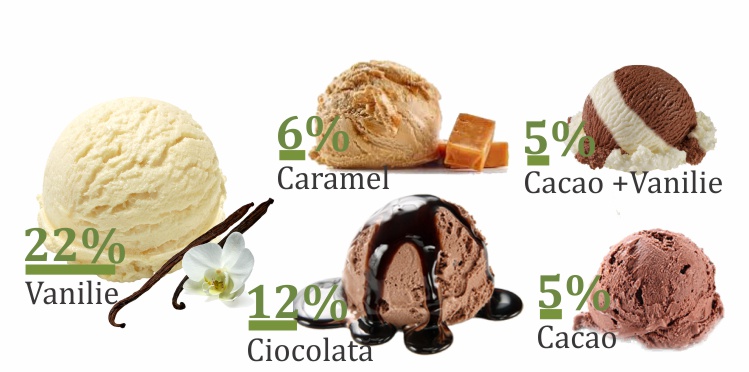
What flavors do Romanians prefer?
vanilla, Chocolate and cocoa still remain the favorite flavors, when we refer to the cool dessert. If in 2015 they accumulated about 75% of the consumer votes, now the percentage reaches about 45%. New flavors proposed by established producers have made their way to the market, such as salted caramel butter of Nestlé, dark chocolate and mint from Corso or maple syrup and raisins of the Romanian manufacturer Alpin 57 Lux. It should be noted that spicy flavors and combinations of chocolate or exotic fruits are starting to be more and more appreciated by Romanians.
Strategies to reduce seasonality
"The 2019 season brought the category a value increase of around 10% in large store chains", notes Revista Progresiv, and stood out for the large number of launches of premium brands, with natural ingredients and even vegetable ice cream. Thus, the new products come to diversify the offer on an already highly competitive market, the producers' objective being to orient the consumer towards this category for as long periods as possible and to reduce the seasonality of sales.

The ice cream market is strongly seasonal. The period of the year with high temperatures, i.e. the months of May to September, covers about 80% of the annual ice cream sales. More precisely, if the months of July and August are the most important for the profile category, each representing between 17-18% of the value of annual sales, at the opposite pole are the months of December and January, which barely reach 2% of total annual sales, STRESSES RetailZoom.
And in 2019, seasonality had a significant impact on ice cream sales, but towards the end of the analysis period, Euromonitor notes a reduction in this phenomenon, thanks to the expansion of modern retailers, who allocated cold rooms more generous for the display of ice cream throughout the year.
Proposing bold ideas regarding ways of consumption or new solutions that cause changes in consumption habits are permanent concerns of profile producers in order to reduce the seasonality of sales.

Artisanal ice cream is gaining ground
From the point of view of consumption trends, in 2019 the producers focused on impulse assortments (single servings). The segment of type "take home" is specific to modern commerce, hypermarkets and supermarkets becoming some of the most sought-after channels for the sale and purchase of ice cream. If, 5 years ago, 21% of consumers chose the refreshing dessert from modern commerce, today, with the development of chain stores, the market share has increased, exceeding 54-55% at the national level.
An opportunity in the development of this segment is represented by the expansion of the cold storage industry in such stores, points out Allied Market Research.
During this time, more and more Romanian brands and companies from the start-up area are visible in the category of artisanal ice cream, which offer unique flavors, produced from natural ingredients, with multiple opportunities in the premium products segment.
Europe – the highest incomes
3,2 billion liters of ice cream were produced cumulatively in the European Union in 2018, 1% more than the previous year, although the productions of the leaders of this segment were slightly decreasing during the analysis period.
Germany maintains its leading position among European ice cream producers in 2018, with 494 million liters of ice cream produced, representing 15,5% of the total production of the European Union. The next places are occupied by France, with 450 million liters of ice cream (14%), and Italy – 435 million liters (13,7%), which loses the second position in 2018.
The European ice cream market holds more than a third of the global market share and is expected to maintain its proportion in the coming period, reaching a value of USD 34,7 billion by 2024, according to Mordor Intelligence. This, analysts say, is due to increased off-season sales, availability of premium offers and consumer interest in innovative products. At the same time, the increased concern for a healthy diet represents a challenge for ice cream manufacturers, who could enrich their range with products from natural ingredients: natural flavors, natural sweeteners and even products with fewer calories and rich in proteins.
Globally, the ice cream market is expected to grow at a CAGR of 4,9% and reach a value of USD 90 billion by the end of 2024, according to Market Watch.
Global trends are similar, with the consumer being influenced more by product performance than price, with the expansion of online food commerce and packaging innovations representing growth factors. In addition, growing popularity of plant-based ice cream such as chickpea, tahini, coconut, avocado, or other unconventional ingredients is estimated to drive the ice cream market globally.
Cecilia Florescu, Nova Pan marketing specialist

. Producţia este în creștere cu 4% față de 2017.)