




• Salt – the seemingly banal story ingredient and yet indispensable to life.
Salt, the seemingly banal but indispensable ingredient in our diet, is extracted from underground deposits (formed from former seas), from the sea or from salt lakes. The two elements essential to our survival, sodium chloride (NaCl), have made salt a highly sought-after ingredient since the dawn of civilization.
Salt – a constant presence in human history
The largest reserves of salt are in the waters of the oceans and in the salt deposits formed by the evaporation processes of the different geological periods.
At the dawn of humanity, man ensured the necessary consumption of salt mainly by assimilating the existing salt in the meat and blood of game, not having to deal with the extraction or processing of salt.

The appearance of stable and organized human settlements, seconded by the beginning of empirical agriculture, led to the need to supplement the amount of salt, mainly as an addition to animal feed and food preservation, and a little later for leather processing or medical treatments.
The first salt used by man is attested to have been collected from plants with a high salt content that grew near salt lakes or ocean coasts.
Other theories suggest that the first source of salt used would have come from water droplets carried by waves on rocks near ocean coasts. After drying, the salt remained on the stone and was collected for use.
Salt in Greco-Roman antiquity
In a article published by Valeriu Cavruc, Vasile Moga and Alexandru Stănescu, we read about the fact that the exploitation of salt in the ancient Greco-Roman world became a real industry, involving both free people and slaves. The salt trade covered vast territories, from the British Isles to the Middle East, from North Africa to Central Europe. The importance of salt exploitation and processing even leads to the establishment of very strict legal regulations.
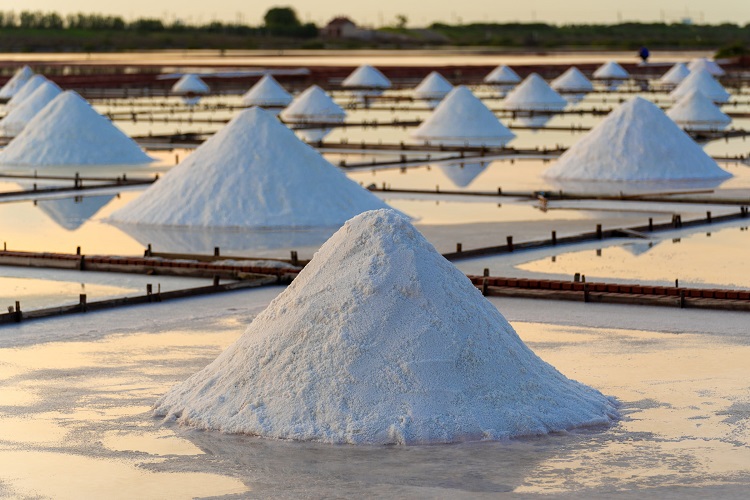
If in the Greco-Roman world salt was obtained through mining, salt pans and mines being considered public good and the resulting incomes were taxed through the so-called "the tax", in England it was also practiced to extract salt from sea water or salty springs, while in Italy and Sicily salt came mainly from salt pans, but also from salt lakes.

In northern Europe, salt was mined as early as 400 BC by the Celts from mines in the mountainous area where the Austrian city is located today Salzburg ("City of Salt"). In these mines the exploitation was particularly dangerous, many times those who extracted the salt lost their lives in the galleries that collapsed on top of them. Their bodies were found in a perfect state of preservation even after hundreds of years. The Celts dealt with the salt trade in the Roman Empire, but also beyond its borders. There were other Europeans who produced salt, among them the Venetians, who sold the precious ingredient to Constantinople.
Salt – loaded with symbols
Salt also has an important symbolic value in most populations. It is used as a purifying element in Shintoism or as an offering, together with bread, in Christianity.
It is also an important element in rituals, from the Hebrew one for sanctifying the victims, to the purification of the household for various populations, to the purification of the space by the sumo wrestlers.
For Greeks, Jews, Arabs, as well as Romanians, salt is a symbol of hospitality and friendship, offering and consuming it, together, having the value of a bond of brotherhood. Thus, the tradition of welcoming guests with bread and salt proves both the hospitality of the hosts and the great esteem held for the visitor.

Exploitation of salt in Romania
The fact that Romania is a country whose natural salt resources are important and at the same time easily accessible has contributed to the special role of the salt sources in our country for this part of Europe. Most of the territories surrounding the Romanian space are either lacking or extremely poor in this mineral.
The testimonies regarding the exploitation of salt in Romania are the oldest in the world, salt being used over the millennia not only for the needs of the local population, but also for those of communities in more or less remote areas.

In many areas of Romania, rich in salt, unlike many European countries, people still use traditional methods of extracting, processing and using salt, perpetuating practices and beliefs related to this mineral inherited from ancient times, even if, over time, their origins and primary meanings have been lost, and people's faith in them gradually declines.
The symbolism of salt among Romanians
In the Romanian space, in various popular rituals, salt is used for its beneficial or evil action. Thus, in the popular customs of predicting the future or meteorological phenomena, finding the bear, purifying the home, salt performs its beneficial effects, while, for completely opposite purposes, it is also used in black magic.

Salt is also often found in popular sayings, which highlight either aspects of daily life or traits of human nature, all of which have complex connotations. Thus, "salt is the sugar of the poor" highlights its importance for humanity, at the same time making a parallel between the way of life of the various social classes. The well-known expression "I love you like table salt" no longer needs any interpretation. On the other hand, through popular expressions like "sweet as salt in the eye" or "putting salt on the wound", by using the connotations of using salt in certain circumstances, negative feelings are expressed.
Article written by Gabriela Dan, Editor of Arta Albă
Read on White Art and: Sugar, the history of sweet gold

