



• Easter is the most important religious holiday of the year, long awaited by Christians around the world. In addition to the religious significance, the Day of the Resurrection of Jesus Christ is marked by various traditions, one of which is the preparation of specific culinary products.
In this chapter, each country stands out with at least one dessert or bakery-pastry product that cannot be missing from the Easter table. It is fascinating how cultures have adapted, acquired and assimilated various beliefs or rituals, when historical sources show that the origins are similar.
Entrepreneurs who own bakeries, patisseries or confectionery can be inspired by the gastronomic culture of other peoples in order to innovate and differentiate themselves from their competitors. On the one hand, they can bring new products to the market, and on the other hand, they can meet the demands of consumers from communities of other nationalities than ours in the country.
Post
During Easter, Romanians are used to eating feed prepared from leavened or unleavened dough, with the addition of cheese and raisins. The dessert is prepared on Maundy Thursday or Saturday, and over time its composition has been revised and modernized.
If the basic recipe involved the use of classic ingredients – milk, eggs, flour, sugar, etc. - currently, we also encounter additions of more sophisticated ingredients - chocolate, vanilla, rum, almonds, cinnamon, etc.
The traditional shape for Easter is the round one, reminiscent of the newborn Baby's diapers. According to tradition, it is decorated with a braided wreath and a cross made of dough.
"The most important baked goods, which both Romanians from Bucovina and Moldova eat during the Easter holidays, is pasca", claims the ethnographer Simion Florea Marian in his study "Romanian Holidays". So, in addition to being delicious, pasca remains in the memory of Romanians the symbol of Easter.
Today's Passover actually represents the unleavened bread of the past and has the role of reminding the sacrifice made by Jesus Christ. Passover is an ancient testimony of pre-Christian customs, when bread and its derivatives had a significant importance during rituals.
Thus, the Jews called Pascha, "matsa" or "bread of the poor", because when they fled from Egypt they did not have time to prepare bread and had to bake unleavened dough. Also in the Hebrew tradition, on Passover the lamb was eaten together with unleavened bread.

Easter dove
The Italian dessert Colomba di Pasqua or Colomba Pasquale is the counterpart of the well-known Panettone, the star of the winter holidays. Loosely translated, "Colomba di Pasqua" means "Easter Pigeon", the name of the dessert indicating the final form of the product (pigeon), while also conveying a message of peace.
The dough is similar to that of Panettone, made from flour, eggs, sugar, natural yeast and butter. Before being placed in the oven, granules of heat-resistant sugar and almonds are sprinkled on the surface of the product, giving it a crispy crust. The core is soft and airy and contains bits of candied citrus.
There are several legends about the origin of this dessert, but the oldest of them dates back to the XNUMXth century, when King Alboin of the Lombardy region besieged the castle of Pavia. It is said that when he surrounded the towered building, he received as a symbol of peace a "sweet bread" in the shape of a dove.
The large-scale production and marketing of the Colomba di Pasqua product is due to Angelo Motta, who invented the famous dessert. In 1919, after the war, Motta opened the first bakery, where he began the production of panettone. The amazing success of this Christmas product made him want a version for Easter, and thus Colomba di Pasqua was born.

Babka Wielkanocna
In Polish gastronomic culture, the product specific to Easter is Babka Wielkanocna, or Babka for short. The dessert is decorated with powdered sugar or white icing, and its texture is fluffy, similar to that of a cake.
Babka means "bread of life" and is eaten by Poles on Holy Sunday. In the Slavic language, "babka" means "grandmother". It is believed that the dessert got this name as a tribute to the grandmothers who are known for cooking many tasty treats and desserts.
The origins are both Polish and Jewish, but the difference is that the Polish babka is baked in a Bundt-type shape, while the Jewish babka resembles a braided bun.

Tarte Tatin
Tarte Tatin is a French tart, often eaten during Easter. The topping contains fruit, usually apples, which are caramelized in butter and sugar before the dessert is placed in the oven. It is a light tart with fruity flavors if eaten as is.
If it is served with ice cream, yogurt or whipped cream, it becomes a more caloric product, but the combination of flavors is also special.
Legend has it that Tarte Tatin originates from a commune in the central area of France, in the Sologne region. At the end of the XNUMXth century, the Tatin sisters ran a very famous hotel-restaurant at the time (Hôtel Tatin), located directly opposite the train station.
Caroline and Stephanie accidentally invented the dessert that would become famous. Preparing a traditional apple tart for their guests, Stephanie Tatin forgot the apples mixed with butter and sugar. He noticed that the fruits had caramelized intensely, so he poured the batter over them, then put them in the oven. After baking, he turned the tart so that the fruit was the top layer. To her surprise, the customers appreciated her "work" very much and thus Tarte Tatin became a specialty of the house.

Kulich
The Kulich product originates from Russia but is known under different names and forms in several Christian-Orthodox countries. The dessert is a baked, semi-sweet product similar in shape to panettone. To obtain the specific shape, it is baked in cylindrical containers.
The product is decorated with white icing, which flows gently around the edges, and colored candies. The domed shape of the dessert imitates the dome of a church, and the white icing signifies the snow on it.
Kulich is consumed only in the period between Easter and Pentecost and has the role of heralding both the Resurrection of the Lord and the coming of spring.
According to traditions in Russia, the product is placed in a basket with dyed eggs and taken to the church to be consecrated. Priests bless this symbol of the Resurrection, immediately after the Easter service. After this ceremony, Christians consume it every morning before breakfast for 40 days.
Kulich that has not been sanctified is eaten as a dessert alongside Pashka, another traditional Easter dish, in Russia.

Tsureki
In Greece, Turkey, Armenia and other Middle Eastern countries the traditional Easter dessert is called Tsoureki and it is a braided bread similar to a roll. Characteristic of the Tsoureki pastry product is its decoration, consisting of whole eggs, painted and "arranged" in the dough braid, which gives the finished product a special appearance.
Eggs are usually red, to symbolize the blood of Jesus Christ.
Tsoureki is a soft and fluffy product on the inside and may contain unique flavors such as mahlepi (black cherry seed powder), mastiha (natural mastic tree resin) or cardamom (sweet-spicy spice).
According to tradition, on Thursday of Holy Week, women knead the dough and then form the product from three braids, thus symbolizing the Holy Trinity. It is possible that its origins are Turkish, given the long Ottoman rule over these territories.
In the Greek tradition, a common custom at Easter is the offering of Tsoureki by children to their godparents.

Signel Cake
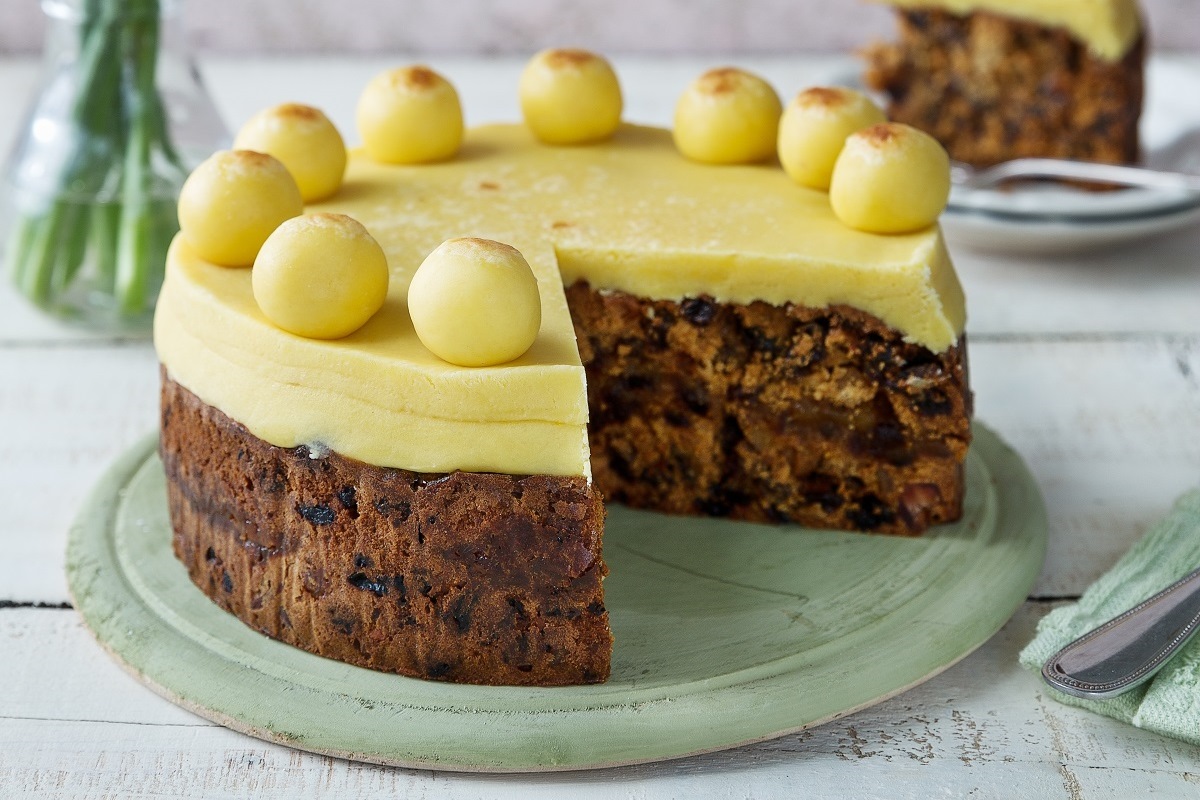
The dessert specific to the United Kingdom and Ireland is the Simnel Cake, eaten both in the run-up to Easter and on Holy Sunday. The cake requires only a few basic ingredients: flour, sugar, butter, eggs, spices for flavoring, dried fruit and marzipan.
Almond paste (marzipan) is used both for layering and decorating the top. Above the layer of marzipan on the top of the cake, 12 or 11 balls of marzipan are arranged in a circle, these signifying the 12 apostles, respectively the 11 apostles without Judas. For a unique flavor, orange blossom water or brandy is added to the top of the cake.
Simnel cake has been known since medieval times, when it was just a bread made with yeast and the best quality flour. In Latin, the word "simila" means "very fine white flour" and it is possible that the name of the product comes from this. It was only at the end of the XNUMXth century that the original bread, later transformed into pudding, came to take on the shape, consistency and appearance of the present cake.
A legend says that Simon and Nelly, an old couple from Wiltshire (England), were the ones who created this cake in 1810. During the Easter holidays, the two of them had a surplus of dough that they could not use anymore what to do. They argued and argued about it, as Simon wanted to boil it and Nelly to bake it.
Eventually they reached a compromise, and the product they obtained became known as Simon and Nelly's cake, respectively Sim-Nel or Simnel.
Article made by Nicoleta Banu, White Art editor.


