


• Purchasing power in Europe for the year 2022 was analyzed by the market research company GFK.
The market research company GFK has conducted a study following which it has launched the purchasing power map for Europe in 2022. Starting from dark blue tones, which reflect the least purchasing power, and moving towards shades of red or cherry, reflecting the highest purchasing power, the map also illustrates the fragmented analysis of each individual state, on the specific organizational forms of the respective country: county, county, city, region. This is necessary due to the fact that the development of areas is not always uniform.

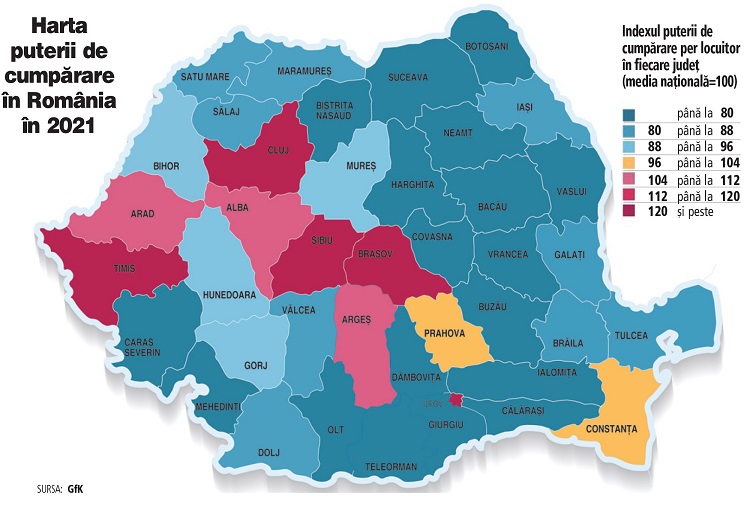
The same market research company cited by BBC, also analyzed the purchasing power for Romania in 2021, the forecast for 2022 being quite gloomy, in the perspective of inflation at a value of over 10%. At the beginning of 2022, in conditions where, at the level of the entire country, salary increases do not manage to equal price increases, analysts predicted a drastic decrease in the purchasing power of Romanians.
The purchasing power of Romania
Analyze GFK company shows that, for the year 2021, a resident of Romania had an average of 7.453 euros for expenses. This means that every month the amount to be spent amounted to around 620 euros, 50% lower than the European average. And yet, at the national level, ten counties in Romania, including Bucharest, have a purchasing power greater than or equal to the national average, raising the statistical figures.
At the European level, Romania is not among the poorest in the south-eastern area, although the purchasing power is low. Countries such as Poland and Hungary are in the same situation. Data provided by the market research company GFK show that the poorest countries in Europe are Ukraine, the Republic of Moldova, Albania and much of Turkey. The countries at the two extremes are Ukraine, with the lowest purchasing power, and Norway, with the highest purchasing power in Europe.
Article written by Gabriela Dan, Editor of Arta Albă.
Read on White Art and: Amaranth, a gluten-free pseudocereal


