




• Panis Quadratus, the characteristic bread of the Roman Empire from the period of antiquity, discovered in Pompeii during archaeological excavations.
• Farrell Monaco, a Canadian food archaeologist, has carried out extensive research at Pompeii, focusing on the Pompeian bakeries dug out from under the ashes and especially on the charred breads, Panis Quadratus, discovered at the archaeological site here.
Over the centuries, archaeologists and historians have carried out important search and research actions in order to discover fragments or clues that can contribute to the reconstruction of important aspects of the history of the Roman Empire.

As a result of the research carried out, it was also concluded that during Ancient Rome, bread was obtained from the flour of common wheat, Triticum aestivum, this being a food intended especially for rich families. On the tables of the poor, where there was usually soup or porridge, bread was rarely found. However, the historians' conclusion is that cereals and bread were a basic component in the diet of the Roman people, they were part of the so-called Mediterranean Triad: cereals or bread, olives or olive oil and grapes or wine.
The tragic event that took place in the ancient cities of Pompeii and Herculaneum, located at the foot of Mount Vesuvius, has always been a subject of great interest to an impressive number of historians and archaeologists. The way in which, in the year 79 BC, the two cities were completely destroyed, and the lives of their inhabitants suddenly ended, by being covered with pyroclastic matter resulting from the eruption of the Vesuvius volcano, aroused the desire of researchers to bring to light the unfolding of events and not only. In this way, scenes and aspects of the lives of the inhabitants trapped in the lava could be discovered as in a time capsule.
Panis Quadratus, the bread discovered in the ruins of Pompeii
Archaeological research in the area Pompei and Herculaneum revealed that, before the Vesuvius volcano tragically and brutally interrupted the lives of the inhabitants of these cities, there were approximately 30 bakeries in Pompeii alone. They produced, daily, important quantities of bread.
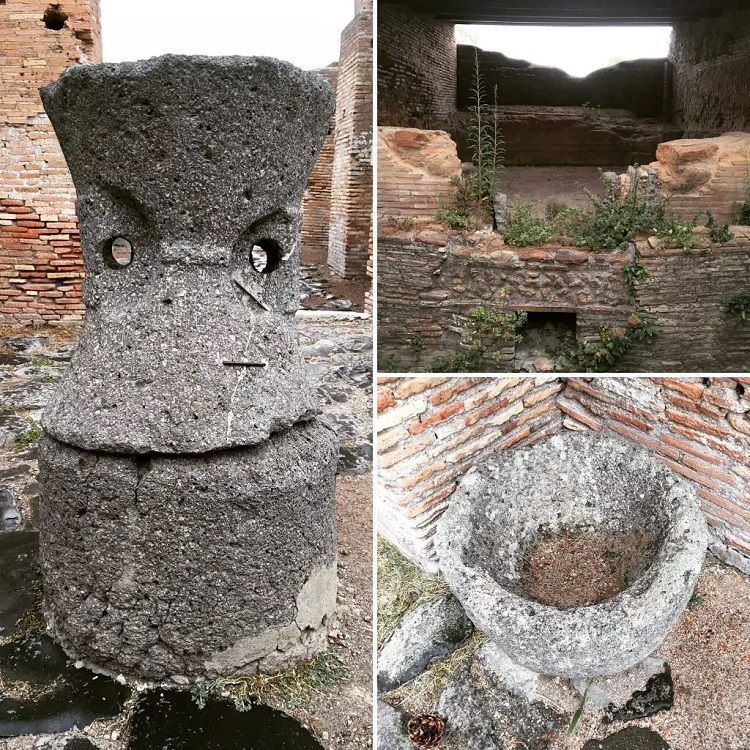
Many of the breads produced in Pompeii, unfortunately, were never eaten again. Thus, archaeologists found, among the ruins of the city, buried in ash and volcanic rock, among many other vestiges, an oven full of charred but intact loaves in what had once been the Bakery of Modestus.
These breads, which have also become a symbol of a disaster, are emblematic of the nutrition of a prosperous civilization two thousand years ago. Their discovery brought to light interesting aspects for understanding the baking processes of the Roman era.
The bread discovered in Pompeii is known as Panis Quadratus (or Panis Siligineus), a bread very widespread in the Roman Empire, its graphic representation also being found in a fresco in the city of Herculaneum.

Made with water, flour and natural yeast, having a round shape, it was divided into eight segments of equal size, also featuring a horizontal groove along the entire circumference. The name Panis Quadratus comes from the four lines used to divide it into eight sections.
Panis Quadratus and its mysteries
Although the round shape of Panis Quadratus is so familiar to us, this type of bread still hides many mysteries:
How was that perfect division into eight segments achieved?
Why was she so divided?
Furthermore, what was the purpose of that horizontal groove present on its circumference?

Canadian archaeologist (resident in California), Farrell Monaco, an expert in food archeology, tried to find answers to these and other questions. Her research focuses on food, nutrition, cooking techniques and dishes used in food preparation in the Mediterranean basin area.
Farrell Monaco has carried out extensive research at Pompeii, focusing on the Pompeian bakeries excavated from the ashes and in particular on the charred breads, Panis Quadratus, discovered at the archaeological site here.
Pompeian bread
Archaeologist Farrell Monaco sought to understand the reasons for this particular shape of the Panis Quadratus, but also the level of production in the ancient city before the volcano erupted. Thus, following the recipe discovered in the ancient texts, using information derived from the study of frescoes and the results of archaeological research, she managed to reproduce the Pompeian bread, with the objective of understanding the preparation process, the proportions of the ingredients, the characteristics of the dough during kneading, baking and the final taste of the product. In this way she discovered some curiosities and tried to find answers to the mysteries that surround this characteristic food and so widespread two thousand years ago.

"The loaves, on average, the Canadian archaeologist explains, measured 20 centimeters in diameter, varying between 18 and 22 centimeters depending on the composition, the temperature of the oven or expansion. Panis Quadratus was made from an ancient type of wheat that was often ground and sifted several times, thus turning it into a delicate flour called siligo. Hence the other name, often used for this type of bread, Panis Siligineus".
The researcher also explains "The name might cause confusion, given the fact that the bread is divided into 8 sections, but if we consider that they were created by four axes, which joined the extremities of the bread, it means to observe four lines and not eight".
The first mystery of the Panis Quadratus remains this: how was it possible to divide its surface into eight identical segments? And what was the reason for creating this shape?
Regarding the reason for dividing the bread into the eight equal sections, Farrell Monaco hypothesized that "the eight segments on the upper part of the bread were probably made to facilitate the breaking of pieces and, later, to use them as edible "cutlery" to the consumption of various foods».

Another mystery of the Panis Quadratus is the existence of the horizontal groove along the entire circumference, a kind of impregnated belt on the edge of the bread.
Among Farrell Monaco's experiments, she tried to replicate the groove by using thick string, which she delicately tied around the bread before baking.
It is not certain that the ancient Pompeians used this method, but Farell's final results after baking his loaves were consistent with the appearance of charred bread discovered at Pompeii. However, the researcher deduced that this way it was possible to keep the shape of the breads more compact. This explains it "These loaves did not consist of two overlapping pieces. This ditch appears to be nothing more than an attempt to control the deformation of the bread in the baking process, due to the temperature in the ovens at the time and the type of yeast used."
Moreover, it claims that this process was probably also adopted to rationalize the reduced space of the baking chamber in the ovens used at that time, thus obtaining loaves of uniform size. These conclusions resulted from Farrell Monaco's experiments with the ancient recipes she discovered and the technology of those times. She was thus able to check the deformation of the breads during baking.
"When baking, the bread deforms outwards, thus eliminating any trace of a groove on its circumference, as can be seen on the breads discovered in Pompeii. However, it still remains a mystery by what method that circumferential trench was created."

Have all the mysteries of the Panis Quadratus bread been solved? Not yet!
A final doubt, which still persists, is the one related to the method by which the central part was obtained, which is smaller in height, as can be seen in the carbonized breads discovered.
Following the research, in the ruins left after the Pompeii disaster, bronze dies for bread, a kind of stamp, were also discovered, used to visibly mark the surface of baked bread. Both Panis Quadratus, but also other types of bread from those times, had to bear, on the upper side, a special marking, made with these dies specific to each Roman bakery. These markings were used to be able to identify the origin of the bread and thus prevent fraud.
Art and history – sources of researchers in the reconstruction of eating habits
If today recipes or photos of various types of food or culinary preparations have become a constant on social media networks, in the ancient world food products or dishes were represented in paintings, frescoes or described in the works of historians of the time. Through them, researchers were able to understand more about the customs and lifestyle of ancient peoples. Also extremely interesting is the conclusion that reveals the fact that the use of certain ingredients or certain techniques in the current Italian cuisine are a continuity of the customs practiced in the ancient world.

Historians' research proves that although the bread of Ancient Rome it was quite dense and different in appearance from what we know today, that's not to say it didn't make up for it in taste. Both the sophist philosopher Philostratus the Elder and Pliny the Elder emphasized in their writings that the use of spices or aromatic herbs in the production of bread was widespread in both the Roman and Greek worlds. The authors describe in detail how, during feasts, pieces of bread were soaked by diners in wine, oil or soups.
In addition to the archaeological remains, the art and literature of Ancient Rome are important tools in the work of researchers. Starting from the study of carbonized bread, discovered in Pompeii, and going through the writings of the time, it was possible to identify the techniques and ingredients used to obtain it. Philostratus the Elder, in his collection of essays "Imagine", describes frescoes or paintings of the time in poetic detail. At the same time, there are several representations of the foods that were found on the tables of Ancient Rome, commented on in the essays of Philostratus.
The ingredients of Panis Quadratus described by Philostratus
In Book II of his work "Imagine" ( Xenia – image 26 ), Philostratus mentions the ingredients added by Roman bakers to the dough of bread or Panis Quadratus. “If you want sourdough bread or eight-piece bread, it's right here in the deep basket. And if you want something savory, the breads also meet this condition – because they have been seasoned with fennel, parsley and also with poppy seeds, the spice that brings sleep…”
The charred bread discovered in Pompeii is one of the rare specimens of organic matter that has survived almost two thousand years. This Roman-Pompeian bread is currently kept at the National Archaeological Museum in Naples.

Today, Panis Quadratus, as well as other bakery products from antiquity, can even be tasted, as a way of going back in time. Is it really possible? Yes, since 2018, food researcher and archaeologist Farrell Monaco has been recreating the recipes of Ancient Rome using ancient methods and marketing the products obtained in her online bakery Pistrinum.
Photo sources: ridiculouslyinteresting.com, tavolamediterranea.com, www.visitnaples.eu, nationalgeographic.com
Article written by Gabriela Dan, Editor of Arta Albă
Read on White Art and: Amaranth, a gluten-free pseudocereal


